
Understanding Cooke County Releases
“Released” means that one custodian ended its physical custody, not necessarily that every criminal case or sentence ended. An adult leaving the Cooke County Detention Center may enter the community after bond, a court order, time served, or completion of a local sentence. The same date-out can instead mark a transfer to TDCJ, federal custody, immigration custody, another jail, or a medical authority. The sheriff record establishes the county custody endpoint; it should not be stretched into proof of where the person went without a destination or release code.
The official county link is deliberately labeled “Check if someone is in custody.” A negative result means only that the search did not return the person as currently held at the time checked. A released adult normally drops from that current roster. The lasting evidence is more likely to be the sheriff's book-in/release sheet, proof-of-incarceration letter, or the court file. State prisoners, federal prisoners, and youth at Gainesville State Juvenile Correctional Facility belong to separate record systems.
How Cooke County Custody Ends
Release routes are not interchangeable. Bond permits release while a case continues. Time served or sentence completion may close the jail portion of a judgment. A dismissal can affect the case without identifying the precise moment jail staff processed a date-out. Parole and mandatory supervision concern state prisoners and may continue after physical release. Probation is court-ordered community supervision and is not parole. A transfer closes Cooke County's custody even though the person remains confined elsewhere.
| Custody endpoint | What it means | Best next source |
|---|---|---|
| Bond | Release while charges may remain pending; payment alone is not proof of exit. | Sheriff date-out plus the correct clerk's bond order and docket. |
| Court-ordered release or dismissal | A judicial event may authorize release, subject to processing and other holds. | Signed court record matched to the sheriff sheet. |
| Time served or sentence completion | The local confinement term has ended. | Judgment, jail credit, and proof of incarceration. |
| Transfer | County custody ended but confinement continued under another agency. | Destination on the sheriff record, then the receiving system. |
| Parole or mandatory supervision | A TDCJ prisoner leaves incarceration under state supervision. | TDCJ history, Board status, and Parole Division. |
| Final discharge | The sentence and any attached supervision have ended as recorded by TDCJ. | TDCJ incarceration history or formal records response. |
Read a Cooke County Release Record
Cooke County's sheriff form is unusually specific about the records available. It describes the arrest report as a “book in/release sheet” showing charges and dates in and out. It also offers a proof-of-incarceration letter containing incarceration and release dates only, plus a clearance letter. The form does not promise a release time, reason, destination, photograph, or every internal code, so those details should be requested rather than assumed.
| Field or document | What it establishes |
|---|---|
| Subject name and date of birth | Helps distinguish people with similar names; compare identifiers rather than relying on name alone. |
| Date in | The start of the documented Cooke County booking or incarceration period. |
| Date out | When that county custody entry ended, subject to the record's precision. |
| Charges | The accusations tied to the book-in/release sheet, not proof of guilt. |
| Release type or destination | May distinguish community release from transfer if the agency maintains and releases it. |
| Proof-of-incarceration letter | A narrow statement of incarceration and release dates only. |
| Court judgment or order | The judicial disposition, sentence, dismissal, or release authority, not the jail's movement log. |
| Supervision record | Whether parole, mandatory supervision, or probation follows physical custody. |
A record may legitimately omit the next destination. When that happens, use the date-out as a starting point and check the court, TDCJ, BOP, ICE, or another named receiving agency. Keep “release from Cooke County” separate from “release to the community.”
Request the Sheriff Release Record
Use the official Cooke County Sheriff Open Records Request Form after a person leaves the current roster. A focused request is easier to locate and less likely to require narrowing.
- Give the person's full name, date of birth if known, and an approximate booking and release range.
- Add the case or incident number when available. Avoid unnecessary identifiers.
- Select the arrest report/book-in and release sheet, or the dates-only proof-of-incarceration letter if that is sufficient.
- In the free-text area, ask for the maintained date and time in and out, release-type or transfer code, and destination or receiving agency if releasable.
- Choose the offered return method: email, fax, mail, or telephone notice for pickup. Save the submission confirmation.
- Match the returned date-out to the signed court order or disposition held by the appropriate clerk.
The form says charges may apply but gives no fixed production price. It also does not guarantee a turnaround. Under the Texas Public Information Act, “promptly” means within a reasonable time and without delay, not automatic delivery within ten business days. The District Clerk's own fillable request says to allow up to ten business days for that court-record route, which is a separate process.
300 County Road 451
Gainesville, TX 76240
940-665-3471
Texas Access and Record Limits
Texas Government Code Chapter 552, the Public Information Act, provides the request framework. It does not make every item in a law-enforcement file public. Privacy provisions, law-enforcement exceptions, juvenile confidentiality, expunction, and nondisclosure can limit production. The government custodian decides what existing material is responsive and releasable and may seek an Attorney General ruling when required.
Release does not automatically expunge a record. Texas Code of Criminal Procedure Chapter 55A governs expunction, while an order of nondisclosure is a different remedy. Eligibility depends on the arrest, charge, outcome, dates, and statutory rules. A lawful restriction should be respected, and a vanished result must not be reconstructed from unofficial fragments.
Cooke Cash Bonds and Release
The detention center page directs users to Bail.Cash for Cooke County for cash-bond information and payment. Gainesville Municipal Court rules add a local detail: Cooke County Jail holds city defendants under contract, remains open 24 hours for bond posting, and accepts cash or surety bonds. These sources describe a bond route, not a guaranteed release time. Staff still must verify the order, other holds, identity, and processing before physical exit.
Jail Volume Is Not Release Volume
Cooke County's FY2025 annual financial report lists 2,236 total persons jailed during FY2025, compared with 1,868 in FY2023 and 1,956 in FY2022; the cited series does not provide FY2024. Those are operating-volume figures. They are not counts of people released, unique individuals, community discharges, or entries in a recent-release feed. The figures show why a precise name and date range matter when requesting a record, but they cannot answer who left custody on a particular day.
Three Cooke County Court Routes
Release-related court records divide by jurisdiction. The 235th District Clerk handles felony records, including judgments and sentencing documents. The County Clerk and County Court at Law route cover misdemeanors. Gainesville Municipal Court handles fine-only Class C cases filed by listed city agencies. The sheriff form warns that the Sheriff's Office does not hold court records. Start with the charge level and case number, then ask the correct clerk for the signed order rather than treating a docket calendar as the result.
Search for a Released Cooke Inmate
There is no official Cooke County 24-hour or 72-hour release list identified in the research. A reliable search therefore follows the record trail instead of interpreting roster absence as release.
- Check the official current-custody search using the exact Cooke spelling and compare identifiers. Record the date and time checked.
- If the person is absent, request the sheriff book-in/release sheet for the relevant range. Use exact dates for a same-day or multi-day request.
- Search the correct court file for a bond order, dismissal, judgment, sentence, commitment, or transfer entry.
- If state prison is possible, use TDCJ while the person is incarcerated, then switch to TDCJ email, telephone, or formal records after the current-only result disappears. Do not confuse a projected release date with the actual date out.
- Check VINELink for a named-person custody change only after confirming that Cooke County or the facility participates. Verify any alert with the custodian.
- For federal or immigration custody, use BOP, ICE, the federal docket, or USMS according to the agency involved.
TDCJ Offender Search and Release
The Texas Department of Criminal Justice search covers people currently incarcerated in a TDCJ facility. It does not produce a historical “Released” or “Discharged” result for a former inmate. The page is updated on working days and says its information is at least 24 hours old. Save the displayed information while the person is present, then use TDCJ's direct channels after release.
| Search input | How to use it |
|---|---|
| Last and first name | Enter the exact spelling; a last name plus at least a first initial is the minimum name search. |
| TDCJ number | A seven-digit identifier is the strongest direct search key. |
| SID number | Use the state identification number when known. |
| Gender and race | Use as refiners, not as substitutes for identity matching. |
| Date of birth or age | Useful in email requests when the TDCJ number is unknown. |
The no-charge TDCJ email-information route can provide incarceration history and a projected date. Send the full name and TDCJ number to `pia@tdcj.texas.gov`; if the number is unknown, provide exact date of birth or approximate age and county of conviction. For an actual release or discharge record, identify the person and custody period in a formal Public Information Act request.
The official TDCJ telephone-status page shows the channels used once parole review is involved.
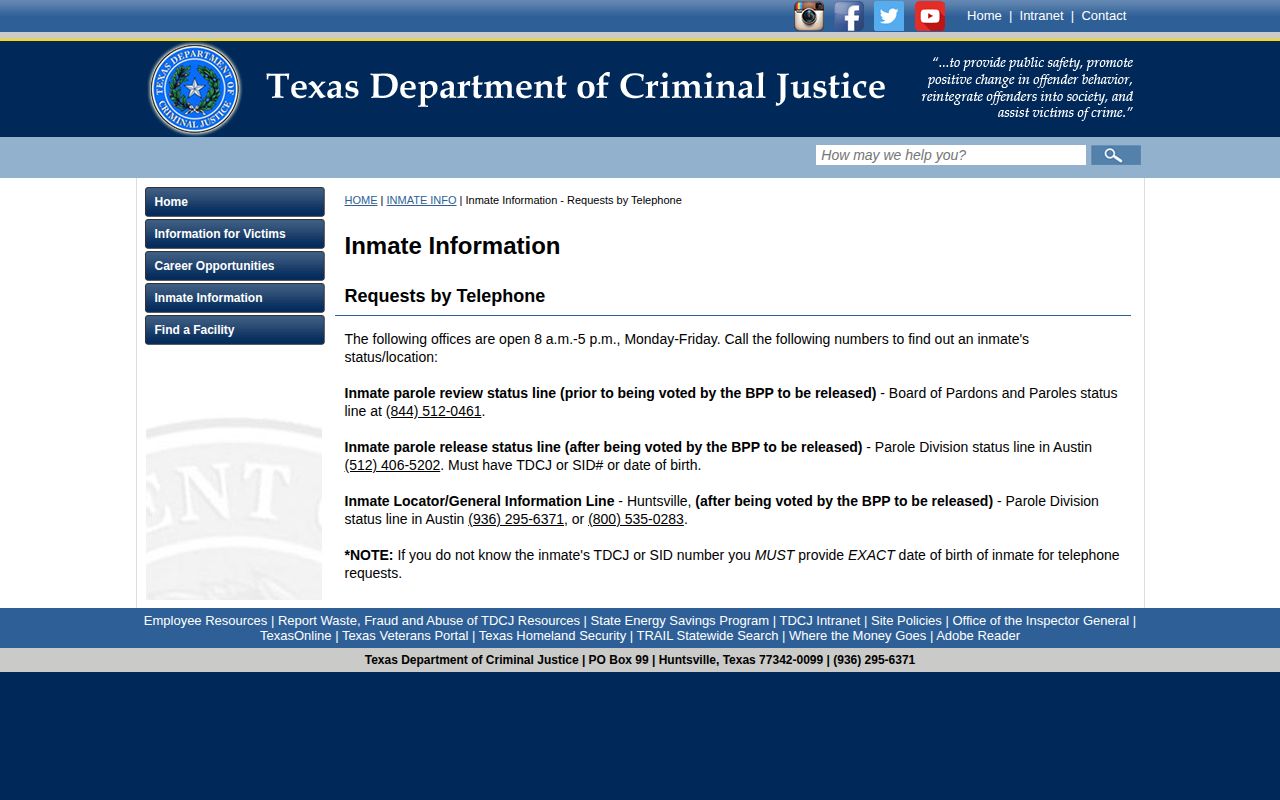
The telephone route separates Board review status from post-vote release status, reinforcing that approval, processing, physical release, and final discharge are different events.
Cooke County Recent Release Lookup
No separate official one-day or three-day release feed was located as of August 2, 2026. The current application is linked only as a custody check, and its fields, update cadence, photo display, and retention were not officially verified. To reconstruct a period, give the sheriff exact start and end dates and request existing book-in/release sheets. Ask for dates in and out and any maintained release or transfer code. A blank current search remains a negative current result, not a historical list.
Verify Parole and Probation
Parole and probation are separate. TDCJ parole or mandatory supervision follows a state-prison release under the Texas Board of Pardons and Paroles and Parole Division. Cooke County is assigned to the Sherman District Parole Office in Region II. Probation, called community supervision in Texas, is imposed by a court and handled locally through Cooke County CSCD. A jail release does not prove either status. Follow the identifiers and case record, then verify the assigned supervision channel directly.
Check VINE, BOP, ICE, or USMS
The Texas VINELink portal can provide a named-person custody-status check and alerts, but the statewide entry page alone does not prove every Cooke County booking participates. Confirm Cooke County or the relevant facility inside the application before registering. Read the agency, facility, status, and update together. “Not found” is weaker than a released status, and even a released status should be matched to the sheriff or TDCJ record.
For a federal sentence, the BOP Inmate Locator covers federal inmates from 1982 forward and displays a release-date field. “Released” or “Not in BOP Custody” means BOP custody ended; another authority or supervision may still apply. ICE's current detainee locator tests present ICE detention but is not a historical Cooke release ledger. USMS manages many federal pretrial prisoners without a comparable public historical release search, so use the federal docket and the Northern District of Texas contact route when appropriate.
Released or Held: Choose the Source
| System | What it can establish | Released-person limit |
|---|---|---|
| Cooke current-custody search | Whether a person is returned as currently held. | No official historical release tab or retention promise was found. |
| Sheriff book-in/release sheet | Charges and Cooke County dates in and out. | Reason, destination, time, and photograph are not guaranteed fields. |
| Court clerk file | Bond order, dismissal, judgment, sentence, or other disposition. | May not show the precise time jail processing ended. |
| TDCJ search and records | Current state incarceration, projected date, history, and direct release records. | The public web search excludes former inmates. |
| BOP locator | Federal status and displayed release date. | Exit from BOP does not prove freedom from every custodian. |
| ICE ODLS | Possible present immigration detention. | No historical county release ledger; absence is not proof of release. |
Plan Transportation Before Release
TAPS Get-a-Ride serves Cooke County with public shared, point-to-point, curb-to-curb transportation. It is not an on-demand jail shuttle. A trip must be scheduled at least 48 business hours, described as two business days, in advance. The scheduling line at 844-603-6048 operates Monday through Friday from 7 a.m. to 3 p.m. That can help when a release date is reasonably predictable, but an uncertain same-day exit needs another plan because a projected date or bond payment is not a guaranteed pickup time.
Gainesville Arrests Use County Custody
Gainesville Municipal Court rules state that a city defendant in custody is held at Cooke County Jail under contract and posts bond there. That makes the Cooke County Detention Center and sheriff record the relevant local custody path, not a presumed separate Gainesville city release roster. The municipal court remains the court-record source for its fine-only Class C cases, while the jail documents the physical custody dates.
Separate Adult and Juvenile Records
Cooke County contains the adult 212-bed county detention center and the Gainesville State Juvenile Correctional Facility, a TJJD institution built in 1916 on about 190 acres. Different agencies operate them for different populations. The adult county roster and TDCJ adult offender search do not provide a public juvenile release locator. Youth information is subject to separate confidentiality rules and authorized TJJD channels; adult public-record assumptions must not be applied to it.
Locate Cooke County Facilities
Cooke County Detention Center is the adult county jail at 300 County Road 451 in Gainesville. Confirm its date-out through the sheriff's book-in/release sheet or proof-of-incarceration letter. A transfer requires following the receiving agency.
Gainesville State Juvenile Correctional Facility is a secure state youth facility operated by TJJD at 1379 FM 678. Youth release or movement occurs under TJJD authority and confidentiality rules, not the county adult roster or TDCJ adult locator.