
Cooke VINELink Coverage Check
Texas participates in VINE through the Texas VINELink portal. VINE stands for Victim Information and Notification Everyday. Its online portal can present custody status and criminal-case information supplied by participating agencies. The useful task here is narrow: locate one person, watch that exact record, and receive notice of a reported release, transfer, or other custody change.
Statewide access does not prove that every Cooke County Detention Center booking feeds the service. No authoritative public participant list was located that confirms complete present coverage. Open the Texas route and check whether Cooke County or the relevant facility appears among the location choices. If it does not, use the sheriff's current-custody search and request its book-in/release sheet. If it does appear, treat VINE as an alert channel, not the final record.
The VINELink service overview is reflected in the captured interface below.
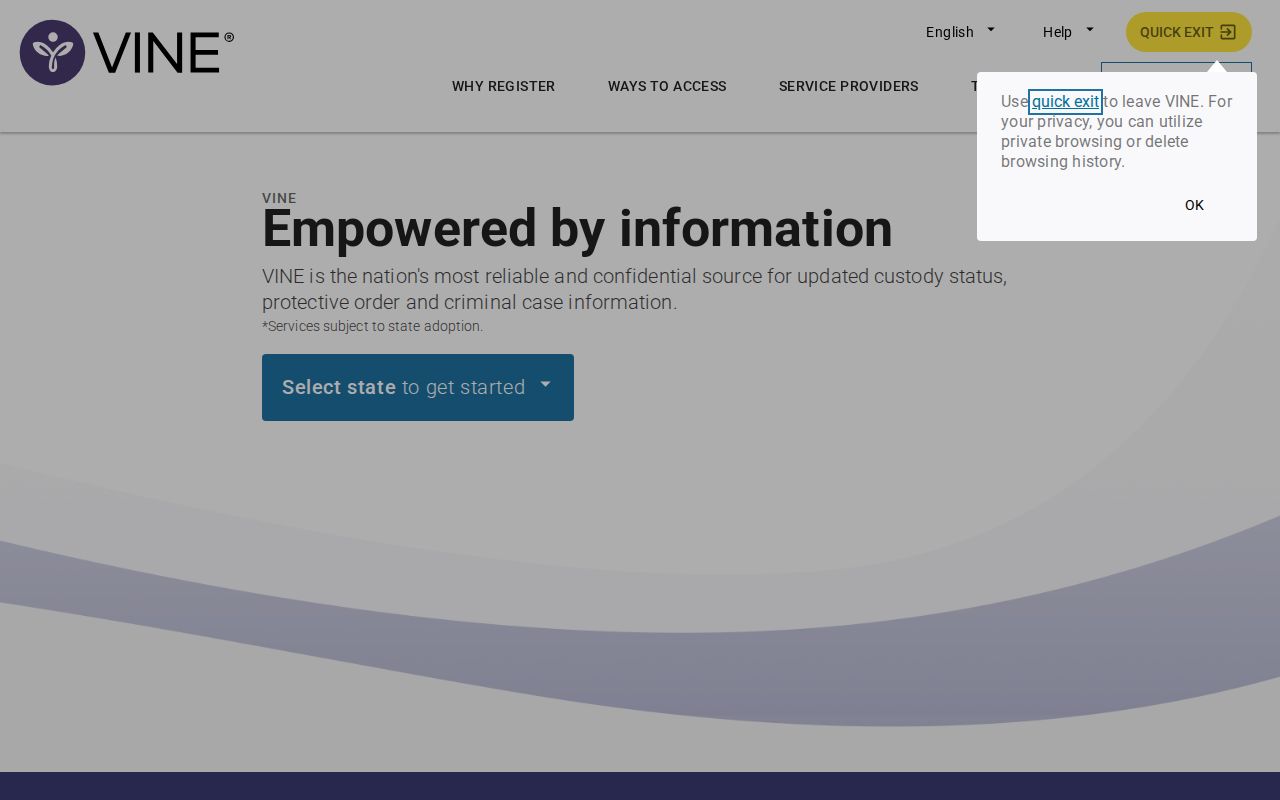
The service view introduces notification access, while the Texas person search supplies the state-specific path.
Search One Cooke County Person
Choose the person or offender search, not the provider or general-resource search. Use an agency number when one is known. A name search can return more than one person, and a name alone is weak identification. Compare every available identifier before opening and watching a record. The portal is dynamic, so the landing screen, results, and alert controls may keep the same visible web address.
- Open the Texas portal and confirm Texas as the location of interest.
- Select the person or offender search. Enter the available full name or identifying number.
- Use the county, agency, or facility choices to narrow results. Confirm that Cooke County is offered before assuming local coverage.
- Compare the displayed identity, agency, facility, status, and other available details. Do not rely on a name match alone.
- Open only the correct person card. Record the source agency and the time or date of the displayed update.
- If the person is absent, try verified spelling and identifiers, then move to the agency record. Never translate “not found” into “released.”
The Texas person-search and registration route appears in the successful manifest capture.
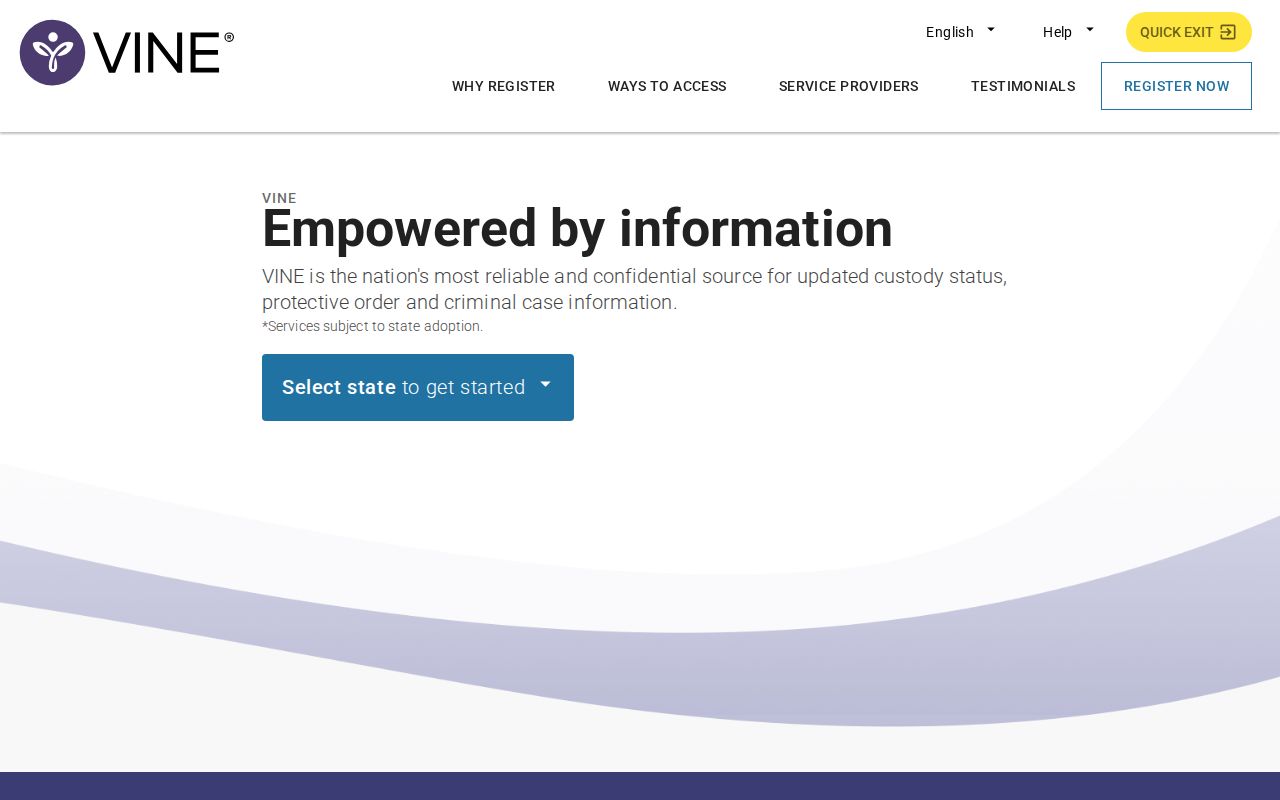
The state screen is the starting point; the facility selector inside the application is the decisive Cooke coverage test.
Read Cooke VINELink Release Fields
A released or out-of-custody label means the supplying agency reported that custody state. It does not explain every legal consequence. The person could have left for the community, moved to another county, entered TDCJ, entered federal custody, or reached another endpoint. Read the status alongside the reporting agency and location.
| Field | What it can establish |
|---|---|
| Person or offender identity | Helps distinguish the selected record; compare more than the name. |
| Reporting agency or facility | Identifies the custodian that supplied the status. |
| Custody status | Shows the agency's reported custody state, such as in custody or released. |
| Update detail | Shows when or how the displayed information was refreshed, if provided. |
| Notification events | Lists the changes available to watch on that record. |
A missing result is weaker than a released label. Spelling, identifiers, agency participation, retention, transfer, and update timing can all affect search results. VINELink is also not a countywide list of everyone released today or during the last three days. The Cooke County released-inmate record path is the better route for a historical or documentary answer.
Registries should remain separate as well. A public offender registry applies only when a person has a legal duty to register. Presence can show registry information; absence says nothing about an ordinary Cooke County jail release. Registry status also does not establish current custody. Use it only for the narrow legal registration question, never as a substitute for VINE, a sheriff record, or a court disposition.
Name confusion creates another local risk. Cooke County, Texas is often confused with Cook County, Illinois. Confirm the final “e,” the Gainesville context, the Texas portal, and the reporting agency before acting on a match. An Illinois custody result belongs to a different jurisdiction and cannot verify a Cooke County event.
Register Cooke Release Notifications
Alert registration begins only after the exact person's card is open. Current options may include text, email, telephone, or an in-app message. Available methods and account prompts can change. Follow the live screen instead of assuming every option works without an account. Select only the event types and contact paths actually offered.
- Choose the option to register for notifications or watch the selected record.
- Select an offered delivery method and language. Enter the requested email address or telephone number.
- Complete any verification code or account prompt shown by the current application.
- Create and re-enter a four-digit PIN. Choose one that can be recalled but is not easy for someone else to guess.
- Review the person, reporting agency, event types, and delivery method. Save the registration.
- For an automated telephone alert, enter the PIN when asked to acknowledge receipt. Use the record or account controls if a call is missed or the PIN fails.
The PIN confirms receipt and is needed to change notifications. Keep it private but accessible. One missed call does not prove that no event occurred. Return to the record, check the current status, and contact the custodian when timing matters.
- Custody change
- A reported move in the person's status, which may include release or transfer.
- PIN
- A four-digit code used to acknowledge or manage notifications.
- Transfer
- Movement to another custodian, not necessarily release to the community.
- Discharge
- The end of a sentence or supervision, which is broader than leaving one facility.
Cooke Victim Assistance Alongside VINE
Cooke County Victim Assistance provides a local information route for crime victims and families. It maps felony matters to the 235th District Court and misdemeanor matters to County Court at Law. That local court split can help a person reach the clerk holding the case record behind a custody event.
The county office is not a VINELink registration tool. It does not replace statewide VINE notifications, and the page should not be used as if it were an alert form. Its role is local navigation and support alongside the statewide custody-notification system. A case outcome still comes from the proper court, and a date-out still comes from the relevant custodian.
The official victim-assistance layer is shown in the county capture below.

This local resource routes court-related help while VINELink remains the separate alert-registration service.
Confirm Cooke Release Alerts
For an adult county-jail event, contact the Cooke County Sheriff's Office and request the book-in/release sheet. The official form says that sheet shows charges and dates in and out. A proof-of-incarceration letter gives incarceration and release dates only. Ask for a maintained release or transfer code and destination when needed, but do not assume those fields must be produced.
Time-sensitive checks should begin with the jail at 940-665-3471. The county's online tool is expressly labeled as a way to check whether someone is in custody. A negative current result is just that. It does not state why the person left the dataset. Preserve the date and time of the check, then compare it with the returned sheriff record. Bond payment is also not proof that staff completed the physical release process.
For a TDCJ event, use TDCJ direct information, parole, or Public Information Act channels. The public inmate search includes current TDCJ prisoners only, so a former inmate's disappearance is not a historical release result. For federal custody, use the Bureau of Prisons locator. VINELink does not replace BOP. If the county date-out was an immigration transfer, use the ICE detainee locator and the proper field office.
TDCJ also operates a separate victim-notification layer for state prison and parole events. Do not collapse it into county VINE. A county-jail release, transfer into TDCJ, parole release, and final discharge are maintained by different custodians. Register with the channel that owns the event, then keep each confirmation tied to that source.
Courts answer a different question. The District Clerk holds felony case records. The County Clerk route covers County Court at Law misdemeanors. Their judgments, bond orders, dismissals, and sentencing records can explain a legal event, while the custodian's record documents the actual custody endpoint. Pair the two when a status label is unclear.
Use this order: alert, source-agency check, release or transfer record, then court disposition. It protects against the key error of calling the end of one agency's custody an unrestricted community release.
When two official sources conflict, report the conflict to the agency that created each record. Do not choose the more convenient status. Ask for the update time, actual date out, release type, and receiving agency if one exists. A corrected source record is stronger than an inference drawn from a delayed notification.