
Cooke Projected Versus Actual Release
TDCJ uses the exact term Projected Release Date. Its Classification and Records Office calculates the date on which a current state prisoner is expected to leave incarceration if not paroled sooner. The offense title, offense date, good-time treatment, mandatory-supervision eligibility, sentence records, and Board action can affect that calculation. It is a current estimate, not a court order or guarantee.
Actual release is the date the person physically leaves one custodian or transfers to another. Parole eligibility is only the earliest point when the Board may consider discretionary release. A favorable vote still requires processing. Maximum expiration is the sentence endpoint if no earlier lawful release applies. Final discharge can occur later, after parole or mandatory supervision ends.
A Cooke County pretrial booking has no TDCJ Projected Release Date. Bond, dismissal, a release order, time served, a hold, or transfer can control the local outcome. Youth at Gainesville State Juvenile Correctional Facility also fall outside both the county adult roster and the TDCJ adult calculation.
Find a Cooke Inmate Release Date
Start with the last known custodian. The Cooke County Detention Center and TDCJ are separate systems. Someone arrested locally will not appear in TDCJ unless a qualifying state conviction and transfer place that person in state custody. A person who leaves the county roster may have moved into TDCJ rather than returned to the community.
- Check the Cooke County detention page when the last event was a local arrest. Its linked online tool checks current custody only.
- If the person is absent, call the sheriff at 940-665-3471 and request the official book-in/release sheet. Ask for dates in and out plus any maintained release or transfer code.
- For a current TDCJ prisoner, search by TDCJ number, SID number, or exact name. Match more than the name and record the displayed Projected Release Date.
- If the TDCJ number is unknown or the result needs confirmation, use the no-charge email route with full name and exact date of birth, or approximate age plus county of conviction.
- Check parole eligibility and Board status separately. Neither is the projected date or proof of release.
- After the person disappears from a current-only search, obtain the actual release or discharge record from TDCJ, the sheriff, or the receiving agency.
The full Cooke County released-inmate lookup helps trace a transfer across systems. The current jail roster cannot serve as a historical release archive, and the TDCJ public search cannot return a former inmate's released profile.
TDCJ Cooke Release Date Search
The TDCJ Inmate Information Search accepts last name, first name, TDCJ number, SID number, gender, and race. Minimum input is last name plus at least the first initial, a TDCJ number, or a SID number. The last-name field uses an exact match. Aliases, compound names, spelling, and identity mix-ups matter.
The public search includes only people currently incarcerated in a TDCJ facility. TDCJ states that it updates on working days and that displayed information is at least twenty-four hours old. Do not use it to prove a same-day departure. When travel or pickup is planned, TDCJ advises calling the unit first.
The official Projected Release Date definition is captured below.
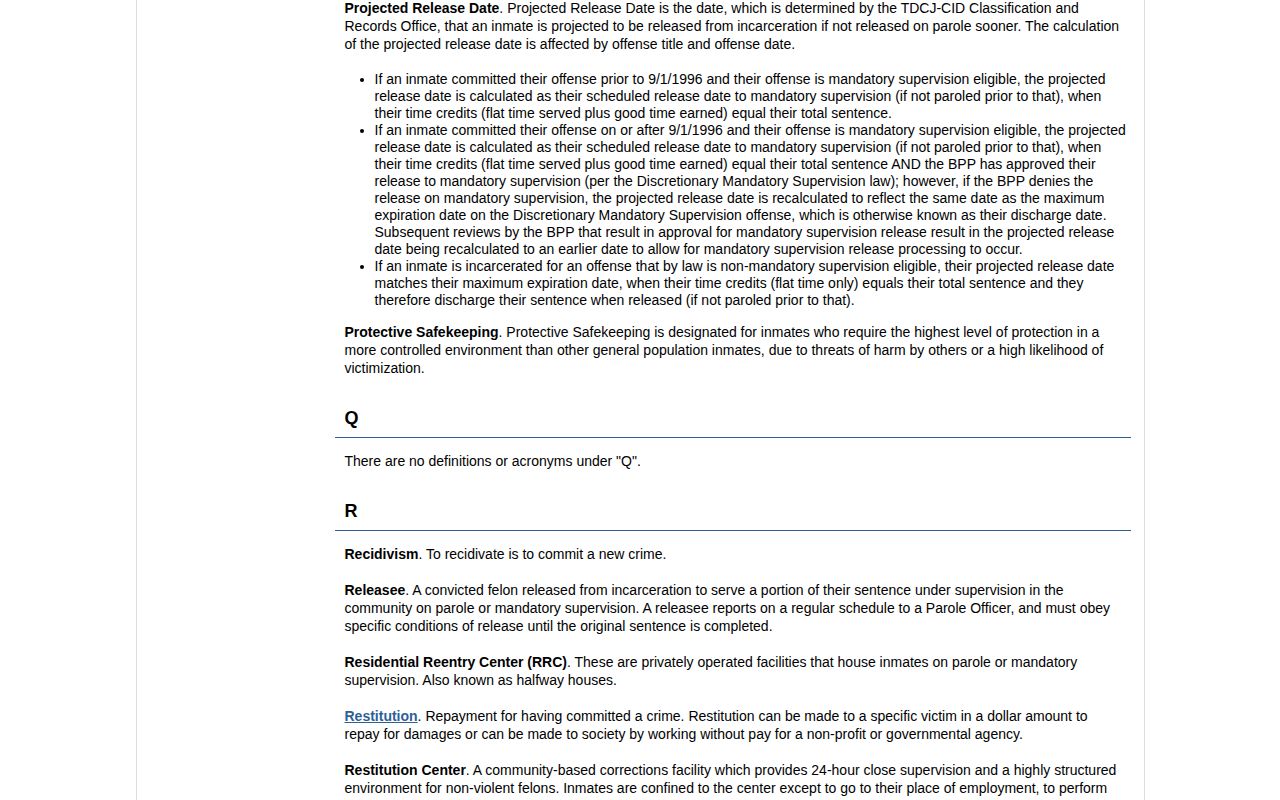
The definition frames the date as a current agency calculation, which is why it must not be presented as a fixed promise.
TDCJ's
email information service
can provide the projected date and incarceration history without
charge. Send the person's full name and seven-digit TDCJ number
to pia@tdcj.texas.gov. When that number is unknown,
provide exact date of birth, or approximate age and county of
conviction. Put the inmate's name in the subject line. For a
former inmate, ask for actual release or discharge date and
incarceration history, not just a projection.
Texas Release Date Calculations
The formula depends on the offense date and legal category. For an eligible offense committed before September 1, 1996, TDCJ may calculate the projected date as the scheduled mandatory-supervision date, assuming no earlier parole, when flat calendar time plus good-time credit equals the sentence. For an eligible offense on or after that date, discretionary mandatory supervision requires Board approval. A denial can move the projection to maximum expiration, while a later approval can move it earlier for processing.
If the controlling offense is ineligible for mandatory supervision, TDCJ says the projected date matches maximum expiration unless parole occurs first. Flat time, not good time, reaches the sentence length in that calculation. Multiple sentences, corrected records, a detainer, or a later Board action can also change the result.
- Flat time
- Calendar time actually served.
- Good-conduct time
- Credit that can affect parole or mandatory-supervision eligibility but does not erase the imposed sentence.
- Parole eligibility
- The point when discretionary Board review may occur, not a release order.
- Maximum expiration
- The sentence endpoint used when no earlier release controls.
- Detainer
- A request or hold from another authority that may affect where the person goes next.
Cooke Release Dates and Good Time
Government Code Chapter 498, especially Section 498.003, governs TDCJ good-conduct time. Good time may affect eligibility for parole or mandatory supervision. It does not otherwise reduce the judicial sentence. Credits may be forfeited and, when law permits, restored. That is one reason the displayed date can move.
Mandatory-supervision eligibility depends in part on Government Code Section 508.149. Parole eligibility is governed principally by Section 508.145. For certain serious offenses, the eligibility threshold generally uses one-half of the sentence or thirty calendar years, whichever is less, without good-time credit, subject to all statutory details and minimums. That threshold permits review. It does not promise release halfway through a sentence.
Texas has no general rule requiring every state prisoner to serve 85 percent. Importing that figure into a Cooke County or TDCJ case produces bad estimates. Texas uses offense-date-specific law, the conviction offense, sentence structure, good-time rules, mandatory-supervision eligibility, and Board discretion. The commonly cited former “3g” term also points to older law; current serious-offense references include Code of Criminal Procedure Article 42A.054.
None of these state formulas should be applied to a short county-jail sentence or pretrial stay. For those cases, use the judgment, jail credit, sheriff record, and sentencing court. Juvenile release information requires an authorized TJJD inquiry.
Why Cooke Release Dates Change
A projected date is a living agency calculation. The cause of a change may appear in a TDCJ record, Board status, court order, or time-calculation record. Do not infer the reason from the new date alone.
| Factor | Possible effect | Best source |
|---|---|---|
| Good-time forfeiture or restoration | Moves an eligibility-based projection | TDCJ time calculation |
| Board decision | Changes discretionary mandatory-supervision or parole processing | Board status and Parole Division |
| Detainer or hold | May send the person to another custodian | TDCJ and receiving agency |
| New or corrected sentence record | Changes controlling time data | Court judgment and TDCJ records |
| Release processing or program placement | Separates approval from physical departure | Unit and Parole Division |
| County court order or bond | Controls a local pretrial release | Court and sheriff date-out record |
A favorable parole vote, for example, is not the day a person leaves. Before a vote, the Board status line is 844-512-0461. After a favorable vote, the Parole Division release-status line is 512-406-5202 and requires a TDCJ number, SID number, or date of birth. Ask whether processing is complete and whether another hold affects the destination.
Confirm Cooke Actual Release Dates
For a county-jail case, the sheriff's official form offers two useful records. Its arrest report, described as a book-in/release sheet, shows charges and dates in and out. Its proof-of-incarceration letter provides incarceration and release dates only. Supply the full name, date of birth, approximate booking range, and case or incident number when known. Ask for any maintained destination or release code if the difference between transfer and community release matters.
For TDCJ, request existing records showing actual release or discharge date, release type, incarceration history, and time calculation. TDCJ's Office of General Counsel accepts Public Information Act requests by email, online form, mail, or hand delivery. The agency decides what is responsive and releasable. A court judgment can explain sentence terms but may not show the moment release staff completed departure.
Register a VINELink Release Check when the relevant agency participates and a prospective alert would help. VINE is an early-warning channel. It does not replace the sheriff's date-out record, TDCJ's actual release data, a federal locator, or the court disposition.
The safe sequence is consistent: identify the system, obtain the current projection, check parole eligibility separately, and confirm the actual release or transfer. After release, determine whether parole or mandatory supervision remains active or final discharge has occurred. Each date answers its own question.