
Cooke Parole Versus Probation
Both systems involve rules in the community, but the legal paths differ. Texas parole is the Board of Pardons and Paroles' discretionary, conditional release of a TDCJ inmate. The person serves the rest of the prison sentence under the TDCJ Parole Division. Mandatory supervision and discretionary mandatory supervision are other TDCJ release types that can also place a person under Parole Division supervision. None is the same as final discharge.
Probation is a court order. Texas agencies call it community supervision. A Cooke County court may impose it instead of imprisonment or as part of a case outcome. The local Community Supervision and Corrections Department, or CSCD, manages the case. Finding probation does not establish that the person ever served a TDCJ prison term. Likewise, a local jail date-out does not reveal whether probation began.
| Point | Parole | Probation |
|---|---|---|
| Source | Release from TDCJ imprisonment | Order from a criminal court |
| Administrator | TDCJ Parole Division | Cooke County CSCD |
| Best verification | Parole Division inquiry or record request | Local CSCD and the court file |
| End point | Final discharge from sentence and supervision | Court-recorded completion or discharge |
Verify Cooke Post-Release Supervision
Begin with the last known event. A Cooke County Detention Center booking belongs to the sheriff, while a TDCJ sentence belongs to the state system. The public TDCJ inmate search includes only people currently incarcerated in a TDCJ facility. It is not a history of released people. Absence from that search cannot distinguish parole, final discharge, transfer, death, or a timing issue.
- Confirm whether the last custody was the Cooke County Detention Center, TDCJ, another county, or a federal agency.
- For a state-prison case, gather the full name, TDCJ or SID number, or exact date of birth. Ask the Parole Division for present supervision and the actual release date.
- For probation, locate the Cooke County CSCD through the Texas CSCD directory. Ask whether supervision is active, transferred, completed, or revoked.
- Match the answer to the court judgment or later order. The 235th District Clerk handles felony records; the County Clerk route covers County Court at Law misdemeanors.
- Request the agency record when a verbal answer is incomplete. Keep parole, probation, custody, and discharge findings separate.
The broader Cooke County released-inmate search path helps when the custody system is still unknown. A sheriff book-in/release sheet shows local dates in and out. It cannot replace the state parole record or a court's probation order.
For a written parole answer, send the full name with the TDCJ
number, SID number, or date of birth. Direct questions about
supervision and location to io@tdcj.texas.gov. Send
Board-process questions to bpp-pio@tdcj.texas.gov,
and Parole Division records requests to
pia@tdcj.texas.gov. For a probation answer, ask the
local CSCD whether the case is active, transferred, completed,
or revoked, then request the matching court order. Staff may
lawfully limit details, so frame the request around the exact
status or record needed.
TDCJ general information is also available at 936-295-6371 or 800-535-0283 during the published weekday office hours. An exact date of birth is required if the identifying numbers are unknown. Ask for the actual release date and present supervision state. A location answer by itself does not show that all terms have ended.
Cooke Parole Office Assignment
TDCJ's county assignment table places Cooke County in the Sherman District Parole Office, Region II. This is the district office serving the county, not proof that every person released from the local jail reports there. Verify the individual case through TDCJ before relying on the assignment.
The official Cooke-to-Sherman assignment is also shown in the captured agency page below.
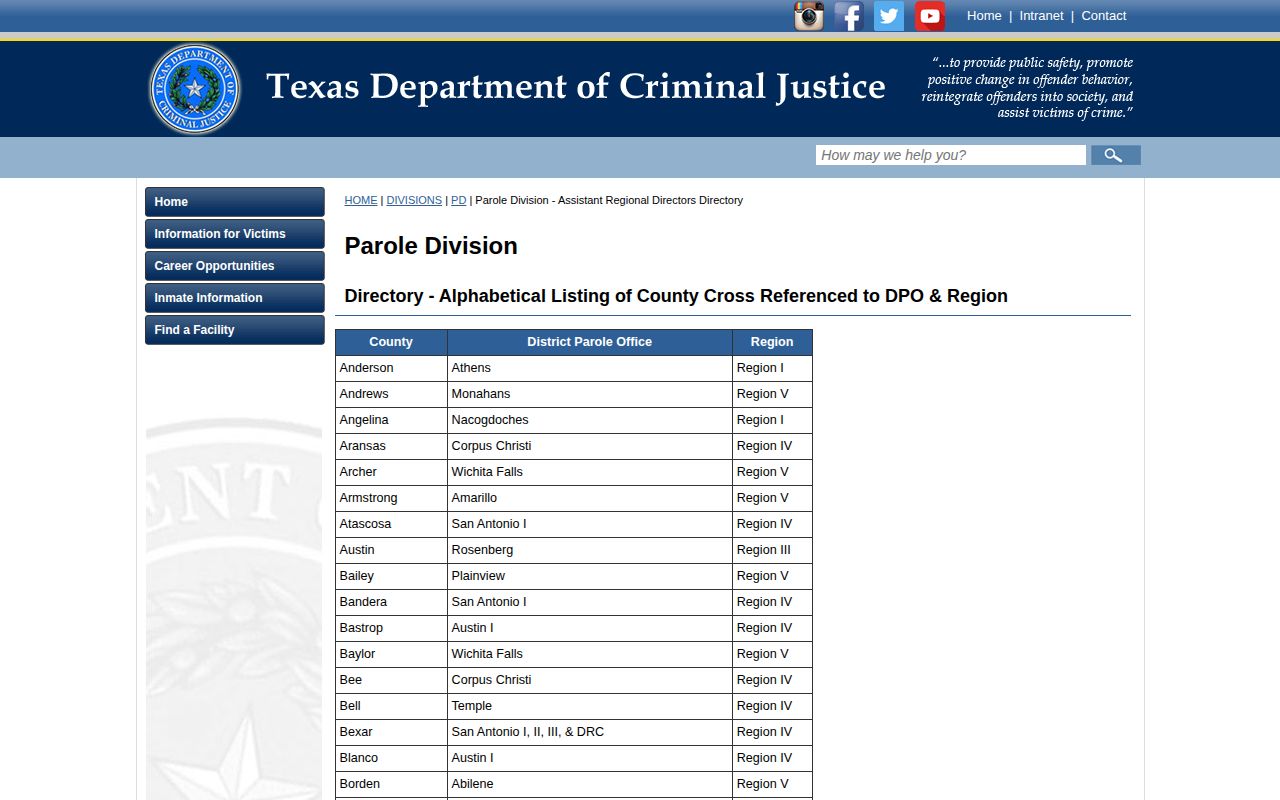
The listing directs Cooke County parole questions to the state district structure rather than the local probation department.
Sherman District Parole Office, Region II2931 Fallon Drive
Sherman, TX 75090
Phone: 903-868-2616
Fax: 903-893-1049
Office staff and assignments can change. Confirm the office
before a visit. Parole supervision and parolee-location
questions may also be sent to
TDCJ parole contacts
at io@tdcj.texas.gov. Parole Division
public-information requests go to
pia@tdcj.texas.gov.
Texas Parole Has No Hearing Calendar
Ordinary Texas parole review is not a public courtroom hearing. The Board's Parole Panel Review FAQ says it does not hold formal hearings for parole or mandatory-release consideration. Panel members review and vote individual case files. Board workshops, open meetings, and agendas deal with agency business; they are not a calendar of named offender hearings.
TDCJ identifies a case before its review point. An Institutional Parole Officer interviews the inmate and prepares a case summary. The file then reaches a three-member panel. Members vote in sequence. Agreement by the first two ends the vote; a split sends the file to the third member. Interviews with an inmate or supporters are discretionary, while qualifying victims have statutory interview rights on request. The official review process is the reliable source for that workflow.
Before the vote, call the Board status line at 844-512-0461. After a favorable vote, call the Parole Division release-status line at 512-406-5202 with the TDCJ number, SID number, or date of birth. Approval may include conditions and still requires release processing. A denial may carry a later review date. Neither outcome creates a public hearing docket, and approval is not the actual date-out.
Cooke Parole Eligibility and Discharge
Eligibility means the Board may consider release. It does not require approval. The law in force on the offense date, the conviction offense, and the sentence control the threshold. Government Code Section 508.145 contains the principal rules, while Section 508.149 lists mandatory-supervision exclusions. Certain serious offenses use one-half of the sentence or thirty calendar years, whichever is less, under detailed limits. Texas has no universal 85-percent rule.
A favorable panel vote is one checkpoint. Actual release from TDCJ is another. Final discharge comes when the sentence and supervision end. Conditions can address reporting, travel, programs, or other case-specific requirements. A violation can lead to enforcement or revocation proceedings, but the public should not infer a violation from a missed contact or stale listing.
Mandatory supervision also needs a precise label. Under older law, an eligible person could be released when calendar time and good-time credit reached the sentence. For eligible offenses committed under the later framework, the Board may grant or deny discretionary mandatory supervision. Both can result in community supervision through the Parole Division, yet the underlying calculation and Board role differ. Ask TDCJ for the named release type rather than using “parole” as a broad label for every supervised release.
The Board's parole guidelines combine a risk assessment with an offense-severity class. Scores run from one through seven, but the official guidelines are neither automatic nor presumptive. Panel members may vote outside them based on the individual file. A score cannot be reverse-engineered into a certain result or date. It is one part of review, not a release calculator.
- Releasee
- TDCJ's term for a person on parole or mandatory supervision.
- Discharge
- The endpoint at which the sentence and applicable supervision end.
- Absconder
- A supervised person who stopped reporting and whose location is unknown.
- Revocation
- A formal action that can end community supervision after an alleged violation is addressed.
Cooke Absconder Status Checks
An absconder is not a person who completed parole. TDCJ defines the term as someone who stopped reporting and whose whereabouts are unknown. That status points to unresolved supervision and possible warrant activity. It should never be described as discharge.
Use the TDCJ absconder channel for official information. Its tip line, 866-680-6667, operates at all times and allows anonymous calls. For probation, contact Cooke County CSCD and check the court file for a motion, warrant, revocation, transfer, or completion order. Privacy rules can limit what an office discloses about an individual.
The local and state records may describe different periods. A person can finish county probation without ever entering TDCJ, or leave TDCJ on parole after a separate state-prison sentence. A supervision transfer can also place the working file in another county while the Cooke court retains the underlying case. Ask which agency now supervises the person and which court will record completion. That prevents an old Cooke address or office assignment from being mistaken for current status.
Close the inquiry with a dated agency answer or record. A live warrant, active supervision, and final discharge are distinct findings. Keeping those labels exact prevents a released person from being wrongly described as free of all supervision.